

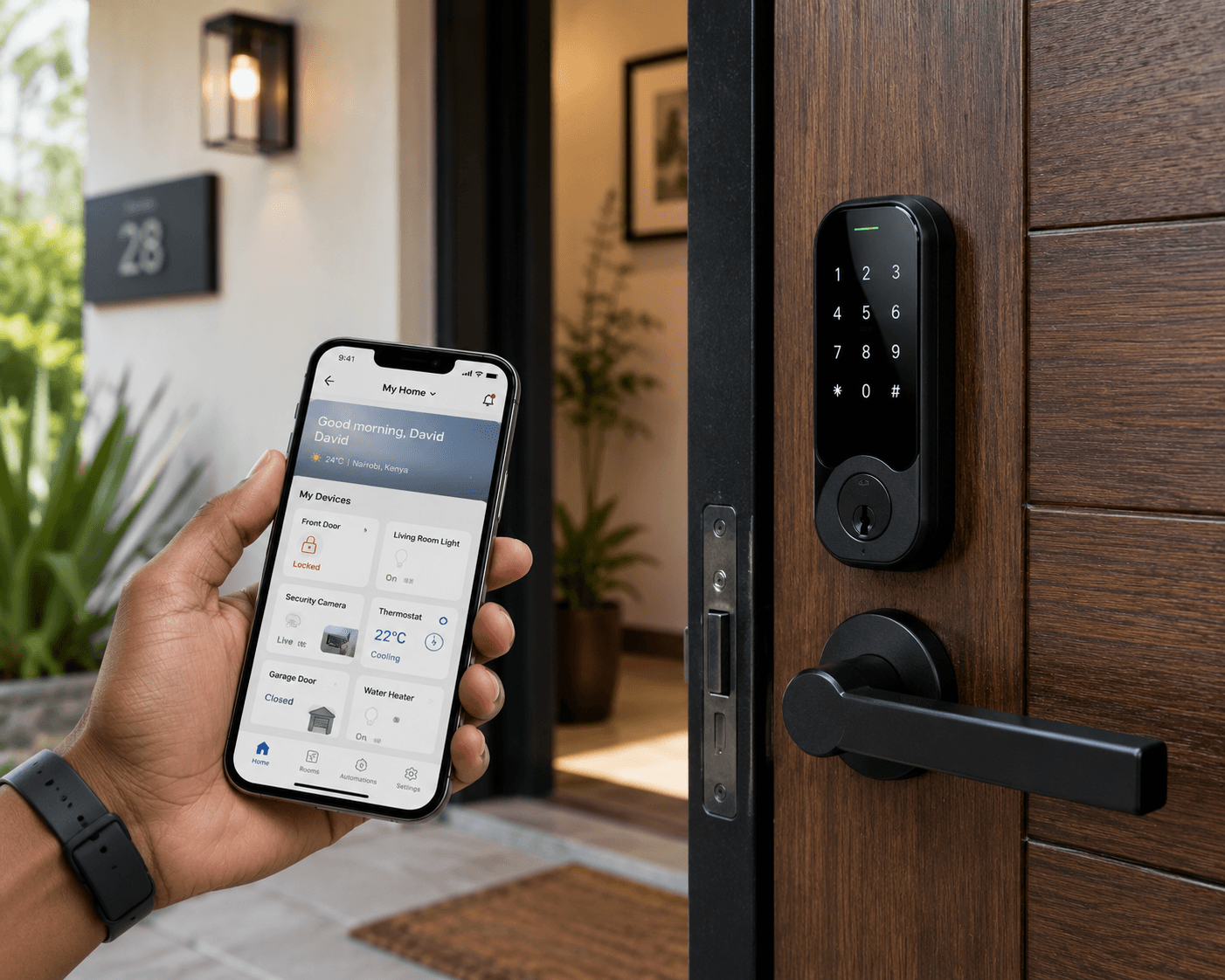
Biometric gates and app-based digital keys are cutting unauthorized entry by double digits in Nairobi's newer estates, and buyers are paying a premium for it.
For years, estate security in Nairobi meant a guard, a logbook, and a boom gate operated by hand. That model scales badly: logbooks are rarely audited, visitor verification depends entirely on the alertness of whoever is on shift, and a guard change at the end of a long shift is exactly when security lapses happen. As gated community living has expanded across Nairobi's growth corridors, developers have started replacing that model with biometric and app-based access control instead of trying to make the logbook work harder.
A connected access-control system can combine credentials, entry logs, cameras and guard procedures. Its effectiveness depends on site design, installation quality, user adoption, security configuration and incident-response practices; performance should be assessed against a documented baseline.
Whether connected security affects rental demand or property values is market-specific. Developers should validate any commercial claim with comparable local transactions rather than assuming that adding devices automatically increases property value.
Delivery and ride-hailing traffic has quietly become one of the strongest arguments for time-limited digital access codes specifically. A resident expecting a boda boda delivery no longer has to walk to the gate or phone down to security; a single-use PIN valid for a defined window handles it, and the estate gets a logged record of exactly who that code was issued to and when it was used, which a shared physical spare key or a verbal instruction to the guard never provided.
A smart-access project should define which entry points are covered, how residents and visitors are enrolled, what happens during power or network outages, and how access events are stored and reviewed. Integration with gates, locks, intercoms and visitor systems must be confirmed for the selected equipment.