
Every drop monitored. Every loss prevented.
Africa's dams and reservoirs are critical infrastructure for millions of people. AdvaIoT deploys the sensor networks that turn raw water data into the intelligence needed to protect them.
3–5h
Flood warning lead time
vs. <30min manual detection
38%→18%
NRW reduction
Within 6 months of deployment
±1cm
Level accuracy
Continuous automated reading
24/7
Monitoring uptime
Battery-backed telemetry
What's broken in Water & Dam Management today
Water authorities and dam operators across Africa manage critical infrastructure with inadequate instrumentation. Water levels are measured manually — a technician drives to the dam wall and reads a staff gauge — providing at best one or two data points per day. In between readings, nobody knows what the level is doing. Flash rainfall events can raise a reservoir by metres in hours, but by the time the manual reading is taken and reported, the downstream communities may already be at risk.
The consequences of that gap are not theoretical. On 9 May 2018, an earth dam on the Patel Coffee Estates in Solai, Nakuru County, failed after days of heavy rain, releasing an estimated 190 million litres of water and killing at least 48 people. The subsequent Senate investigation found a structure built from porous material with no proper spillway, where underground seepage had gone undetected and unaddressed for years. A government audit that followed found that of roughly 4,140 dams across Kenya, only 843 were formally regulated and inspected — leaving more than 3,200 structures, many of them smaller, privately built, or agricultural dams exactly like the one at Solai, with no one able to vouch for their current condition.
Evaporation from large open reservoirs is Africa's invisible water thief — accounting for 20–40% of total storage losses in hot, arid regions — yet most water authorities don't measure it. Pipeline distribution losses are equally unmonitored: a major pipe burst can drain thousands of cubic metres before anyone notices a pressure drop. Water theft by illegal connection is rampant and undetected. The authority bills for what was produced, not what was delivered — and the gap grows.
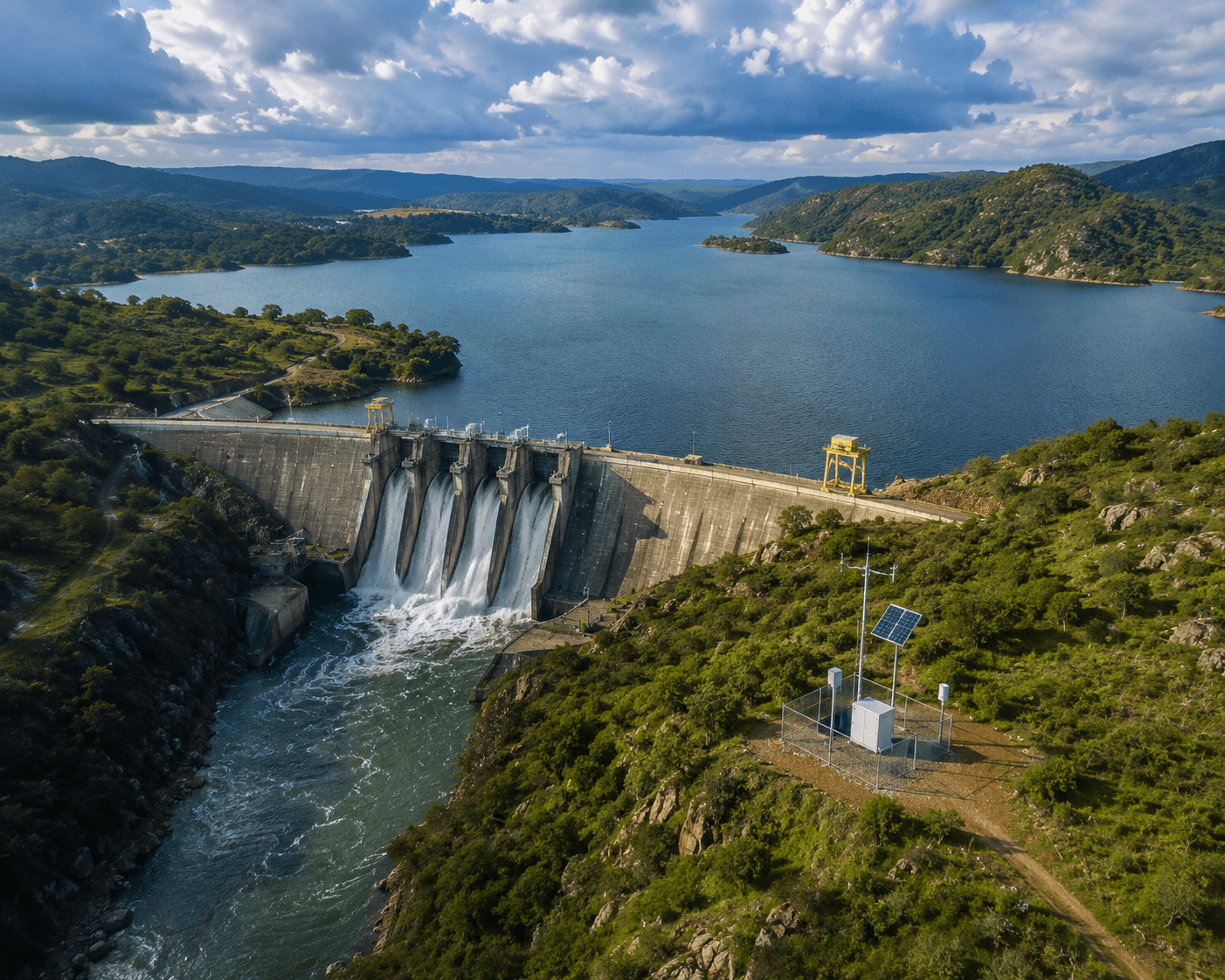
AdvaIoT deploys IoT sensor networks on dam walls, intake structures, distribution pipelines, and reservoir perimeters. Water level sensors report continuously — every 15 minutes at minimum, every minute during flood events — feeding a live dashboard that water authority engineers can access from anywhere. Automated alert thresholds trigger warnings at defined levels, giving downstream communities and emergency services advance warning time they've never had before.
Flow meters on inlet and outlet structures allow water balance calculations that quantify evaporation, seepage, and distribution losses accurately for the first time. Pipeline pressure sensors identify flow anomalies that indicate leaks or illegal connections within hours rather than weeks. The data transforms water resource management from reactive crisis response to proactive engineering decision-making.
Turning water & dam management data into decisions
- Real-time water level monitoring across reservoirs and dams
- Evaporation rate tracking and seepage anomaly detection
- Pipeline flow monitoring to identify and locate leaks fast
- Structural sensor integration for early dam safety warnings
- Regulatory compliance reporting for water resource authorities
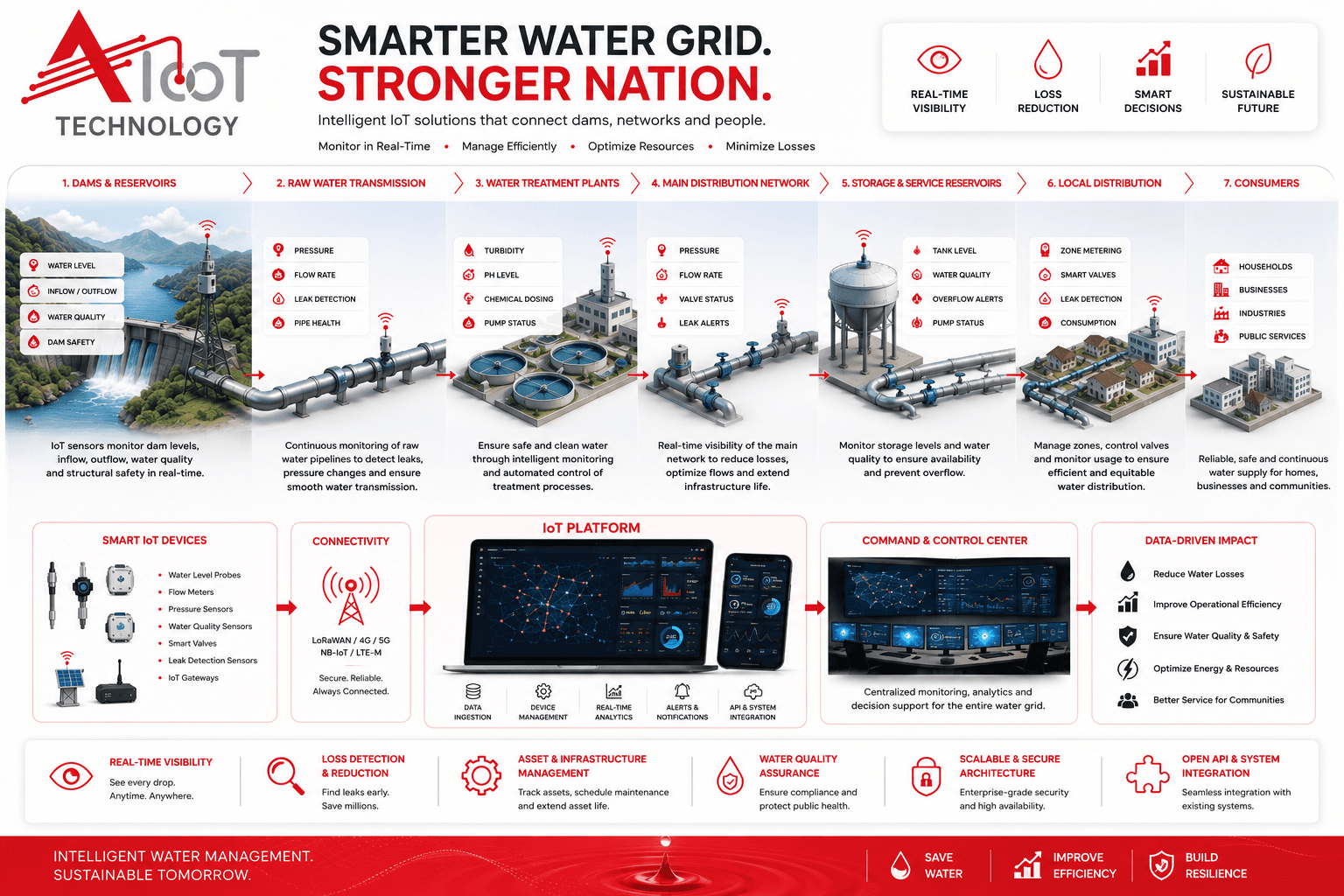
The Smarter Water Grid, End to End
AdvaIoT's water grid platform doesn't stop at the dam wall. The same sensor network and dashboard extend across every stage water passes through on its way to a tap.
Capabilities
Purpose-built IoT solutions for water & dam management operations across Africa.
Continuous Water Level Monitoring
Ultrasonic and pressure-based water level sensors reporting every 15 minutes in normal conditions, every minute during rapid change events. Accurate to ±1cm across full operating range.
Evaporation Rate Tracking
Pan evaporation sensors and weather station data combined with surface area models to calculate actual daily evaporation from reservoirs — enabling accurate water balance accounting.
Flood Early Warning System
Automated alerts to emergency services, downstream communities, and water authority management when water levels approach defined flood thresholds. SMS, email, and siren integration.
Pipeline Flow & Pressure Monitoring
Flow meters and pressure sensors on distribution mains identify burst pipes, illegal connections, and significant leakage zones within hours of occurrence.
Structural Health Sensors
Piezometers and settlement sensors on dam walls and spillways monitor seepage pressure and structural movement, providing early warning of potential stability concerns.
Catchment Rainfall Monitoring
Rain gauge networks across the catchment area feed inflow prediction models. Alerts when upstream rainfall patterns indicate significant inflow within 2–6 hours.
Water Authority Dashboard
Unified dashboard showing all reservoir levels, flows, structural readings, and alerts across the water authority's entire infrastructure portfolio.
Regulatory Compliance Reporting
Automated generation of water level reports, water balance accounts, and structural monitoring summaries for regulatory submissions to WRMA and other authorities.
How it works in the field
Flood Early Warning Upgrade
The Situation
A water authority managing a major dam on a flood-prone river had no automated early warning system. Historical flood events caused significant downstream damage because communities had less than 30 minutes of warning — enough time to do almost nothing.
The Outcome
Continuous water level monitoring with catchment rainfall sensors provided 3–5 hours of advance flood warning for the next significant rainfall event. Emergency services pre-positioned, downstream communities were evacuated safely, and infrastructure was protected. Zero casualties compared to two deaths in the previous flood event.
Non-Revenue Water Reduction
The Situation
A water utility was losing an estimated 38% of distributed water as non-revenue water — the gap between what was pumped and what was billed. Manual pressure tests at selected points were insufficient to pinpoint losses.
The Outcome
Flow meters and pressure sensors at zone inlet points identified three loss zones accounting for 70% of total NRW. Pipe repair in those zones reduced NRW to 18% within 6 months, improving revenue recovery by 20M KES annually.
Ageing Dam Wall Structural Monitoring
The Situation
A regional water authority operating a decades-old earth dam had no instrumentation to track seepage or wall movement, relying on visual inspection walks that could miss slow-developing structural issues until they became serious.
The Outcome
Piezometers and settlement sensors installed along the dam wall now report seepage pressure and movement continuously. An early upward trend in seepage pressure was caught and investigated within days, allowing preventive remediation well ahead of any risk to the structure's integrity.
How we deploy
Hydrological Assessment
Our engineers review the dam and distribution system, existing instrumentation, and historical flood/loss data. We design a sensor network that addresses the highest-risk monitoring gaps.
Sensor Network Installation
Level sensors, flow meters, rain gauges, and structural sensors are installed by our engineering team. All installations comply with WRMA technical standards for dam safety instrumentation.
Telemetry & Alert Configuration
Data telemetry is configured via GSM or radio links depending on site connectivity. Alert thresholds, escalation chains, and emergency communication procedures are established with the authority.
Operational Integration
Authority engineers are trained on the dashboard and alert protocols. Monthly data reviews with our team identify trends and refine alert thresholds as seasonal patterns emerge.
Proof in the field
A water authority managing 4 dams and 850km of distribution mains
Challenge: No automated flood warning on the most flood-prone dam, 38% non-revenue water losses with no pinpointing capability, and WRMA safety reports relying on once-weekly manual readings.
Result: Sensor network deployment provided continuous data for WRMA compliance, 3–5 hour flood warning capability, and identification of three loss zones responsible for 70% of NRW. Annual revenue recovery of 20M KES from improved billing.
4 dams
Fully instrumented
5h
Flood warning time
KES 20M
Annual revenue recovery
38%→18%
NRW reduction
24/7
Level monitoring
Early
Leak detection
Real-time
Evaporation data