
Cities that see everything. Waste nothing.
African cities are growing faster than the infrastructure built to serve them. AdvaIoT gives municipalities the connected intelligence layer to run better cities today — not after a decade of capital projects.
42%
Street lighting energy savings
With adaptive dimming
28%
Junction delay reduction
Adaptive traffic pilot results
35%
Waste truck trips saved
Dynamic routing from bin sensors
90min
Flood warning lead time
From upstream sensor alerts
What's broken in Smart Cities & Government today
Nairobi, Lagos, Kigali, and dozens of African cities are managing rapid urbanisation with analogue tools. Street lights that burn all day or sit broken for months because nobody knows they're out. Traffic lights running fixed-time programmes designed in the 1990s that create gridlock at junctions handling 3× their intended volume. Waste trucks that run fixed routes whether bins are full or empty, burning fuel and creating overflow at busy sites while passing empty ones.
Air quality data is collected by a handful of government stations and updated weekly — useless for real-time health decisions. Flood early warning systems are non-existent in most cities, meaning surprise flooding causes deaths and economic damage that could have been prevented with 2 hours of warning. City officials make billion-shilling decisions without a single dashboard showing them the current state of their infrastructure.
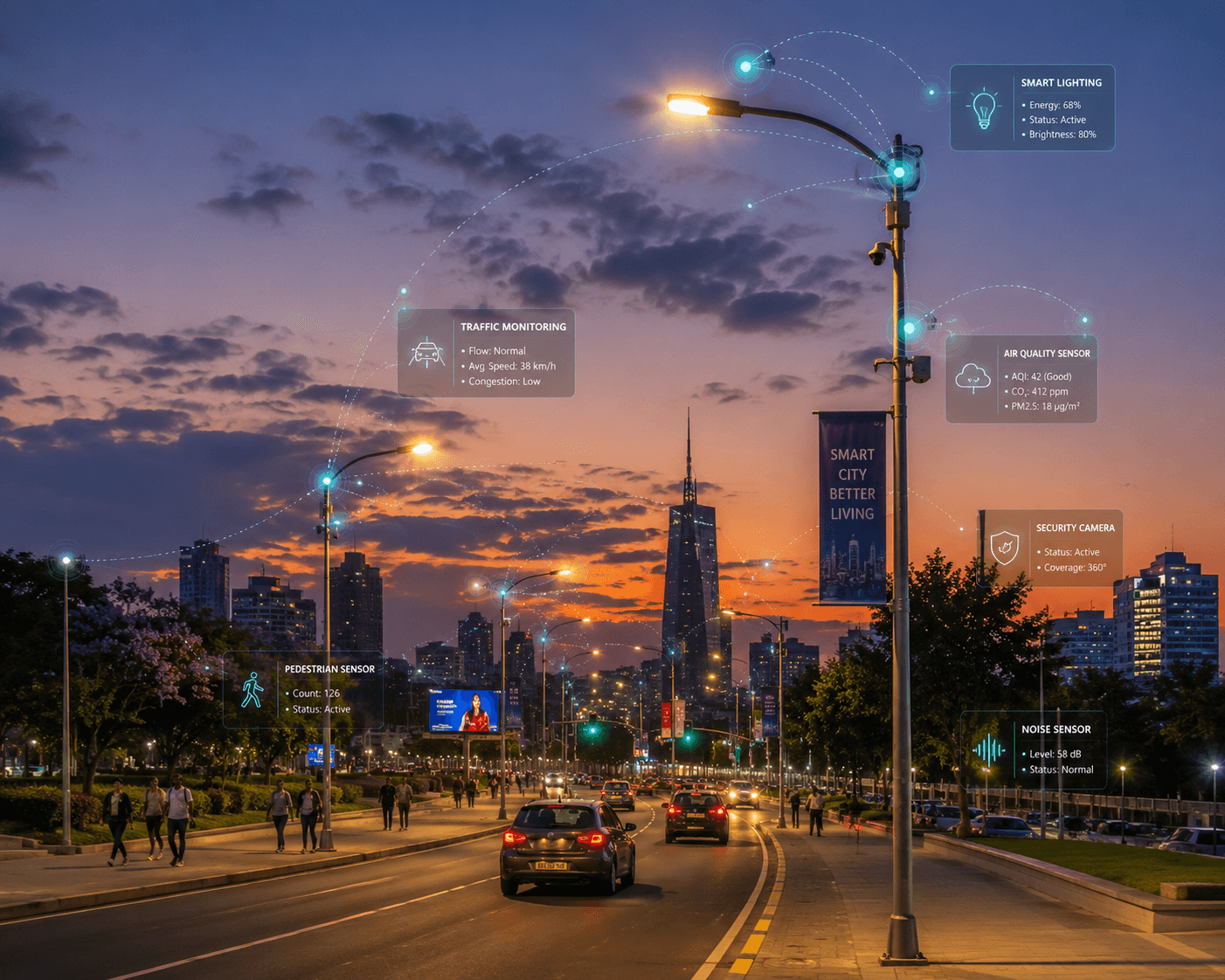
AdvaIoT builds the IoT backbone that turns physical city infrastructure into a living, data-generating network. Smart lighting controllers on every street lamp report status, power consumption, and faults in real time — maintenance teams only go where a light is actually broken, and adaptive dimming cuts energy consumption by up to 42% without reducing safety.
Traffic sensors at key junctions collect real-time vehicle counts, speed, and queue lengths. Adaptive signal controllers adjust green light timing dynamically based on actual flow — not a fixed programme. IoT waste sensors on public bins alert collection teams when capacity hits 80%. Environmental monitors track PM2.5, NO2, noise levels, and flood water levels across the city, feeding an operations dashboard that gives city management teams a live pulse on their urban environment.
Turning smart cities & government data into decisions
- Adaptive smart street lighting with remote fault detection and dimming
- Intelligent traffic signal control and junction flow analytics
- Smart waste bin monitoring with optimized collection routing
- Air quality, flood, and noise monitoring across urban districts
- Public safety surveillance with IoT camera integration
- Unified city operations dashboard for county and municipal teams
Capabilities
Purpose-built IoT solutions for smart cities & government operations across Africa.
Smart Street Lighting
Networked LED controllers with remote dimming, fault reporting, and adaptive schedules. Maintenance teams receive precise fault locations — no more patrolling entire routes to find broken lights.
Adaptive Traffic Management
Vehicle detection sensors and adaptive signal controllers that respond to live traffic volume, reducing junction delays and improving throughput at congested intersections.
Smart Waste Monitoring
Ultrasonic fill-level sensors in public bins transmit collection requests when capacity hits threshold. Collection routes are dynamically optimised, reducing vehicle trips by up to 35%.
Air Quality Monitoring
Dense networks of low-cost air quality sensors providing city-wide PM2.5, PM10, CO, NO2, and O3 readings at 15-minute intervals. Public health alerts and pollution hotspot mapping.
Flood Early Warning
Water level sensors on drainage channels, rivers, and low-lying roads. Automated alerts to emergency services and residents via SMS when flood thresholds are exceeded.
Public Safety Surveillance
IP camera networks with edge analytics for incident detection and crowd monitoring. Integrated with city operations centres and emergency response teams.
City Operations Dashboard
A unified browser-based dashboard for city managers showing live lighting status, traffic flow, waste levels, air quality, and incident alerts across the entire municipality.
IoT Connectivity Infrastructure
LoRaWAN and NB-IoT network deployments to provide citywide sensor connectivity at low cost — purpose-built for African city infrastructure budgets.
How it works in the field
Municipal Street Light Energy Savings
The Situation
A county government managing 8,000 street lights had no idea how many were working, which were burning daytime, or how much energy each circuit was consuming. The electricity bill was a fixed estimate — almost certainly wrong.
The Outcome
Smart controllers deployed across all 8,000 lights revealed 1,200 faults and 340 lights burning 24 hours. Adaptive dimming and fault-driven maintenance reduced the electricity bill by 42% in the first year, saving the county over 18 million KES.
Traffic Decongestion at Nairobi Junctions
The Situation
Three major city junctions were operating on fixed-time traffic signals that caused extreme delays during morning and evening peak hours, despite off-peak periods being significantly quieter.
The Outcome
Vehicle detection sensors and adaptive controllers reduced average junction delays by 28% during peak hours. Fuel emissions at the junctions dropped measurably. The pilot justified expansion to 12 further junctions.
Flood Early Warning in Informal Settlements
The Situation
A low-lying informal settlement in Nairobi experienced three flash floods in two years with no warning. Each event caused property damage, road closures, and two deaths attributable to the absence of early warning.
The Outcome
Water level sensors on three upstream drainage channels provided 90-minute advance warning of flood conditions. The county emergency team used the warning to issue alerts and pre-position response teams. Zero casualties in the following rainy season.
How we deploy
City Assessment
Our urban technology team surveys the target district — mapping lighting circuits, traffic junction volumes, waste bin locations, and air quality monitoring gaps — to build a prioritised deployment plan.
Infrastructure Deployment
Hardware is installed in phases, prioritising the highest-impact interventions first. We work with county electrical teams and city engineers to integrate with existing infrastructure.
Operations Centre Setup
The city operations dashboard is configured, trained staff are given access, and alert protocols are established with relevant city departments — transport, public health, waste management, and emergency services.
Data-Driven City Management
Monthly reporting packages give city leadership quantified performance data — energy saved, faults resolved, traffic improvements, and air quality trends — to inform budget decisions and public reporting.
Proof in the field
A county government in Central Kenya managing a major urban centre
Challenge: 8,000 street lights with no monitoring, a fixed electricity bill with unknown waste, and no data on junction performance or waste collection efficiency. Budget pressure made operational efficiency critical.
Result: Smart lighting controllers, junction sensors, and waste bin monitors deployed over 6 months. Annual savings of 26M KES on street lighting alone. The county now uses live data to justify infrastructure budget requests to the national government.
8,000
Lights connected
KES 26M
Annual savings
42%
Energy reduction
6 mo
Full deployment
42%
Energy savings
8,000+
Connected streetlights
Real-time
City dashboard