

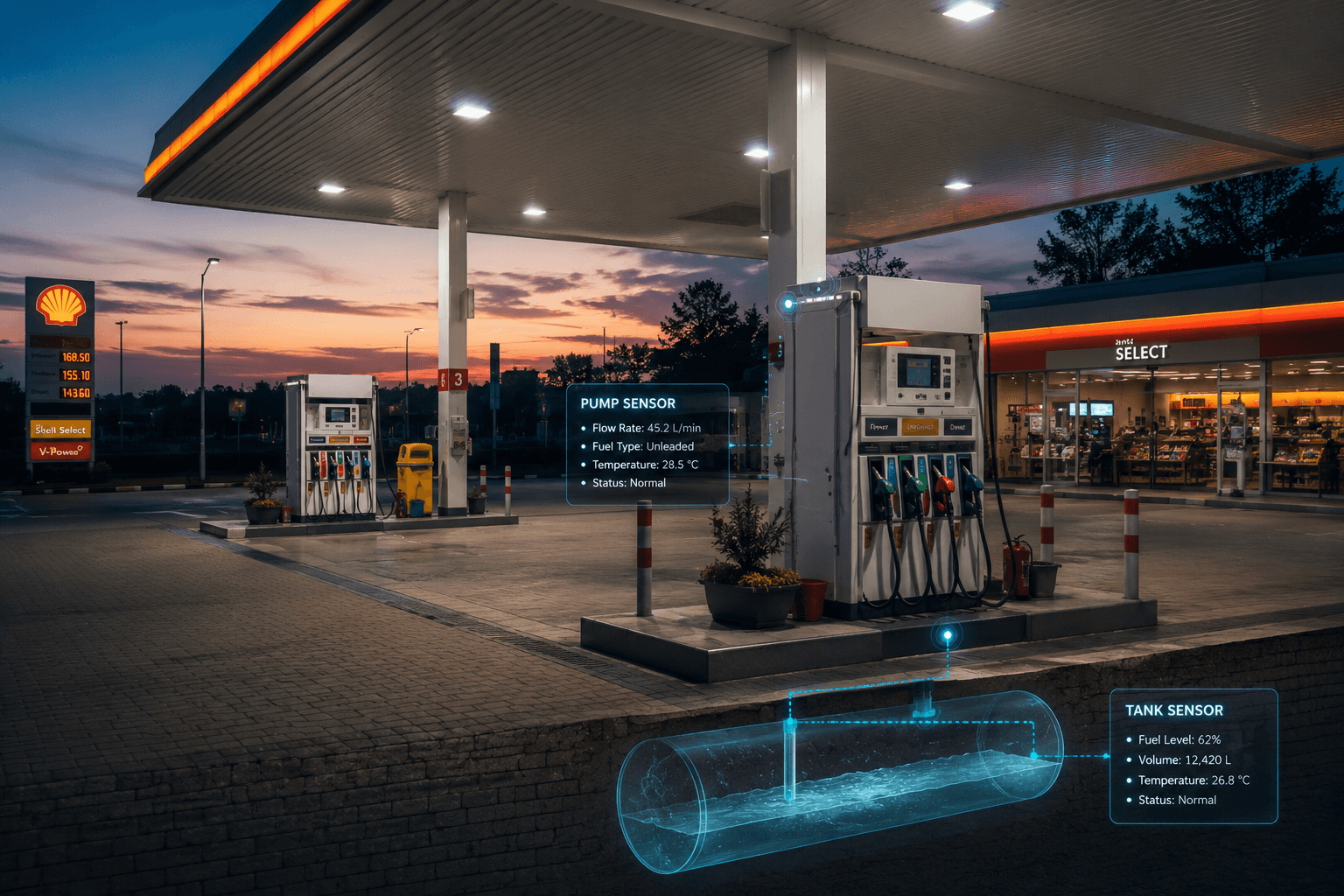
More visibility across forecourt and fuel-retail operations.
Every drop of fuel unaccounted for is a shilling lost and a liability created. AdvaIoT closes the gap between what enters your tanks and what leaves your pumps — down to the millilitre.
Project scope matters
The examples on this page describe possible applications. Final device selection, integrations, permissions, service arrangements and performance measures are confirmed against the site and project requirements before implementation.
What's broken in Oil, Gas & Forecourt today
Petroleum retail and distribution is one of Africa's most loss-prone businesses. Manual tank dipping at fuel stations is inaccurate by design — a 1-centimetre reading error translates to hundreds of litres of unexplained variance. Fuel theft at the pump, short-delivery by tanker drivers, and undetected tank leaks compound daily. Most fuel retailers discover the magnitude of their losses only when monthly reconciliation reveals a gap they can't explain.
For oil and gas companies managing pipeline networks and bulk storage, the stakes are even higher. Pressure anomalies signal leaks that can go undetected for weeks, contaminating groundwater and creating catastrophic liability. Manual inspection schedules don't catch intermittent faults. Tanker fleet managers have no visibility into delivery compliance across their network of depots and customers.
AdvaIoT's forecourt management system replaces manual dipping and human reconciliation with continuous, tamper-resistant automation. Capacitive probes inside each storage tank report levels every minute. Every pump transaction is reconciled against tank drawdown automatically. Variance beyond 0.1% triggers an alert — not a monthly shock.
Our tanker tracking system gives petroleum distributors end-to-end visibility from depot loading to customer delivery. Each tanker is fitted with GPS tracking and compartment-level load sensors that verify what was loaded and what was delivered at each stop. Delivery fraud and short-delivery are eliminated because every transaction is documented in real time.
Turning oil, gas & forecourt data into decisions
- Automated tank level monitoring and fuel reconciliation
- Real-time pump control and transaction monitoring
- Fuel tanker tracking and delivery verification
- POS and ERP integration for seamless operations
Capabilities
These options can be evaluated against the operating environment, existing equipment, connectivity and project scope.
Continuous Tank Level Monitoring
Capacitive or magnetostrictive probes reporting tank levels every minute. Temperature-compensated volume calculations replace inaccurate manual dipping permanently.
Real-Time Pump Reconciliation
Every pump transaction is matched against tank drawdown in real time. Variance above threshold triggers instant alerts to site managers — not end-of-month surprises.
Theft & Fraud Detection
Identify pump fraud, drive-offs, attendant skimming, and delivery short-landing through cross-validation of pump meter, tank sensor, and POS transaction data.
Tanker Fleet Tracking
GPS tracking of every tanker with geofenced depot and delivery point alerts. Route deviation and unauthorised stop notifications sent instantly to operations teams.
Compartment Load Monitoring
Axle load sensors and compartment flow meters verify delivery volumes at each offload point. Cross-reference loading records against deliveries to detect short-delivery.
Leak & Overfill Detection
Water-in-fuel sensors, overfill prevention alerts, and consumption anomaly detection that flags tank leaks before environmental contamination requires costly remediation.
Multi-Site Operations Dashboard
Manage your entire forecourt network from one dashboard. View live tank levels, pump status, daily reconciliation, and variance alerts across every site simultaneously.
POS & ERP Integration
Native integration with popular POS systems and ERP platforms. Sales data, fuel reconciliation, and inventory figures flow into your accounting system automatically.
Where connected systems can help
The examples below describe possible operating scenarios, not claims about a named customer deployment.
Multi-Site Fuel Station Network
Operational context
A petroleum retailer with 12 stations across Nairobi and the Coast was experiencing unexplained fuel variance averaging 3.2% per month across the network. Manual investigation was slow and inconclusive, and losses were estimated at over 5 million KES monthly.
Bulk Fuel Distributor Delivery Audit
Operational context
A bulk fuel distributor supplying 80 commercial customers across three counties had persistent disputes with customers claiming short-delivery. Without delivery data, disputes could not be resolved and relationships were deteriorating.
Underground Tank Leak Detection & NEMA Compliance
Operational context
A fuel retailer operating an older station in a dense commercial district had underground storage tanks approaching the end of their design life. A slow leak could go undetected for weeks under manual dipping, risking groundwater contamination and a NEMA compliance breach before anyone noticed.
How we deploy
Site Survey & Assessment
Our engineers visit each station to assess tank infrastructure, pump types, POS systems, and existing monitoring. We design a deployment plan that minimises downtime.
Hardware Installation
Probes, controllers, and communications hardware are installed by certified engineers. Stations remain operational throughout. Typical station installation takes 4–6 hours.
Reconciliation Configuration
We configure product grades, variance thresholds, and alert recipients for each site. POS and ERP integrations are tested and verified before go-live.
Live Monitoring & Support
Your operations team gets access to the multi-site dashboard. Our support team monitors for hardware faults and responds within 4 hours to any site issue.